Some opening notes:
- I expect you to have surface level knowledge of secondary dominants secondary diminished chords, and maybe the circle of fifths. Or else you might get a little lost.
- I refer to modes to the article. However, modes aren’t important honestly. I also wrote an accompanying article on modes if you want a better understanding on modes.
- For the sake of the article, I II III IV V VI VII will always refer to the degrees in the major scale.
- I also labeled the ranges of greek modes from dark to bright which the chord is included in. Sometimes it’s a good metric how distant two chords can be.
- I added some non diatonic chords because they are useful.
- The categories aren’t strict since it’s very situational and arguably subjective.
- This article has a lot subjective takes but if you are in my blog, you are probably used to it.
Relative Minor and Major
If we look at harmony alone without melody, you will quickly realize that many chord progression do not have a clear tonic. This usually happens when you have a major chord but then you also have a minor chord that has a root minor third below the root of the major chord. If the root of the major chord is tonic, then you would have a I chord and vi chord. If the root of the minor chord is tonic, then you would have a bIII chord and a i chord. Because both tonics are possible, then the labels of the other chords are relative!
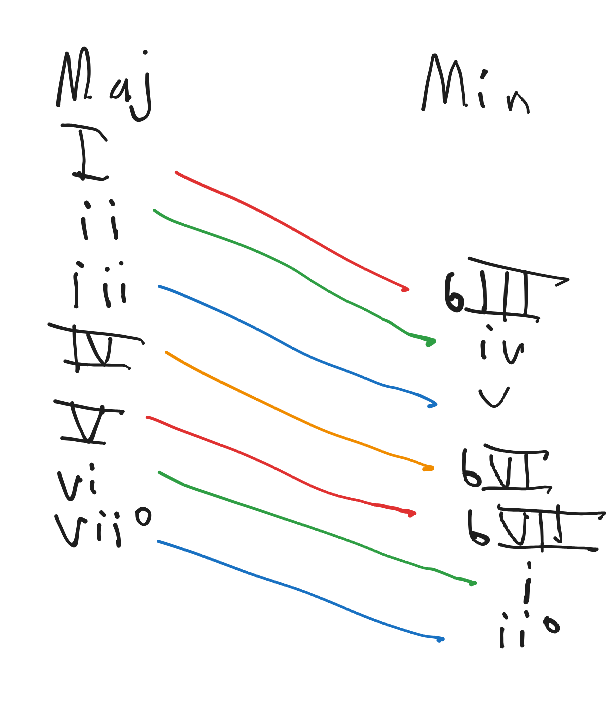
In fact, pairs often share the similar functions in the overall picture. Well, there are exceptions. But for the rest of the article, I will call the right side, relative major and the left side, relative minor.
Tonic Chords
Tonic chords very useful and often interchangeable. For example, in royal roads chords after the first two chords, to be honest you can basically choose any tonic chord afterward, and the progression will sound the same. Well it’ll sound cliché, because Royal Roads is not innovative.
I (Mixolydian - Lydian)
The default tonic chord.
- It’s very useful for vamps since you can jump to literally any other chord from the one.
- If you are using i, going to I all of a sudden can add a heroic surprise (a Picardy Third)
- However, I feel this chord can be cheerful, especially at the start.
- I feel like starting on this chord is kinda boring too, but boring is also good.
- It’s common to use its first inversion to lead to IV.
bIII (Phrygian - Dorian)
Pretty much the minor version of the I.
- It’s a really good filler chord in minor chord progressions.
- It can also give a sense of wonder if used in a major context. Surprisingly, it’s not hard to write a melody over it.
biii (Locrian)
This is a fun dark chord for video game tracks where you don’t want to commit to functionality. I usually use for vamp mostly. It is also fun to use this chord to go to VII.
VI (No mode)
- I usually use this for a surprise chord usually after a V. It’s like a Picardy Third but in major if you think about it, if that makes sense.
- Otherwise, this chord sounds weird at times?
- It’s probably a good chord for any sort of modulation
- It leads well into ii/II.
i (Phrygian - Dorian)
- If you play this chord in a major song, it’s gonna be super tragic.
- It’s a lot more neutral than I in my experience, so it’s easier to use.
- Really, this is like a skeleton chord to keep your music together.
vi (Mixolydian - Lydian)
- Like bIII, vi is a common filler chord when you are making a chord progression, giving mixing emotions in a major song. In fact, in the majority of songs I looked at while making this article, vi is as fundamental of a chord as I.
- I often pair this chord with I.
- A lot of the time, it leads to ii.
Subdominant Chords
These chords are more tense than tonic chords, so you usually want to move up to a dominant or resolve to tonic.
IV (Dorian -Ionian)
This chord is powerful.
- Feels very lush
- Builds momentum to a V or III often
- Can resolve to tonic
- Pivotal chord in progressions like Royal Roads and Komuro and many genres in general
- Has a lot of rich Dorian flavor in a minor context, basically cheat code to make your music sound like fantasy
- You literally can play any note in the major scale (relative to the tonic) over this, and it’ll sound good. Basically it plays all the buttery jazz notes.
That being said, it’s a safe chord which is often overused. However, this is probably one of the most useful chords.
iv (Locrian - Aeolian)
This is a chord which exist. But to be honest, I rarely use this chord just because they are better chords in minor. I only use it as a filler chord when voice leading is convenient.
There is also one cool and pretty common use of iv. If you start with the major version, IV, and then iv (or even you are nerdy, add a major seventh to both), you get the sound of heartbreak. You’re welcome.
bVI (Locrian - Aeolian)
- Basically the minor relative chord to IV, sharing many of the same properties.
- It also shares a lot of note with i, so sometimes you can sub i with bVI if you want something intense. A good example is this Touhou track around 0:38.
- Speaking of Touhou, it’s pretty common to see Touhou music go from bVI bVII I. It’s also a easy device to use.
ii (Dorian - Ionian)
- ii is like a darker, subtler version of IV with the same capabilities.
- However, from personal experience, I feel like it’s harder to prepare, and you likely want to jump somewhere like vi. So, ii isn’t a chord I reach out first, only if I want IV but more minor or have better voice leading.
- Like IV, you can play anything in the major scale of the tonic, and it’ll always sound good. It’ll in fact sound like a folky because you just made dorian.
- Part of the ii V I trio.
- The diminished chord really sounds good for ii before V.
- Invert this once, and you have a nice baseline to V
II (Lydian)
This is often in a form of a secondary dominant chord to get into V. Furthermore, because it’s Lydian, it’s probably one of the brightest chords out there so you’ll this chord sometimes in pop or rock songs. However, I rarely get this chord working much like ii.
bVII (Aeolian - Mixolydian)
According to axis theory, this is a dominant chord, but in my experience, harmonically, it sounds more modal so it’s going to be subdominant for me.
- bVII makes a good filler chord in a minor chord progression, giving a passage between bVI and i.
- Combining I, bVII, and bVI gives a very warm, beautiful sound. Check out the chorus of this amazing song.
- The relationship between bVI and i is similar to the relationship of bVII and ii so it’s not rare you see the two chords together.
- You can also suspend this chord like its relative major, V. Check out this guitar cover, it’s all the Asus4.
bvii (Locrian - Phrygian)
I don’t really use this chord, but I have seen used as developing a preexisting bVII chord or as a substitute to.
Dominant Chords
Some people think that just because a chord is dominant, you must resolve in some cadence. Usually, this is true, but exceptions exist like V to IV.
V (Ionian - Lydian)
V is like salt. It can taste so good, but too much will give you a heart attack. You can use V as a gateway to any tonic chord according to Axis Theory, even #IV if you are crazy. This is a good chord if you want to make a modulation. There is also a jazz trick where you can use a passing #iv° chord to go to IV (reverse order works), but I’m never used that before.
- V with a suspended fourth sounds good generally if you want softer version of V, though also you can create the suspension to resolve to the normal V.
- I guess this is a good time to talk about IV with the fifth of the tonic being the bass note. For example, F/G in C major. This is like a V9sus4 chord. This is very popular in pop music and really sounds nice.
- There is also the ii chord with the fifth being the tonic. I exists, but I never used it.
v (Aeolian - Mixolydian)
- v is V but less cool.
- It feels more relaxed and natural in minor contexts, but honestly is more of the protein most of the time to get the chord progression going.
- It also can be used as a secondary ii V I for the IV which is excellent setup to a new section. Surprisingly, the v doesn’t sound dark when used like this.
bII (Locrian - Phrygian)
- You can use this tritone sub.
- However, what is commoner is if you are in Phrygian where bII is like an intense bVII.
- You can vamp this with i, and get the sound of a Pokémon battle.
- It also can sound a little mystical at times too, especially when you resolve to I.
- To be honest though, it’s very rare to see this chord in the wild like in a pop song.
vii° (Ionian)
This chord is like a dissonant bVII, with an extra pull to I or i. Because it’s diminished, it’s also pretty spicy if you get it to sound good. But to be honest, I see more secondary diminished chords than a normal one. Maybe an exception to Touhou.
Weird Chords
#iv° (Lydian)
This diminished chord is most useful as passing chord between (mostly) IV or V. I also found its half diminished version being used in an idol anime song (see verse). Surprisingly, it’s pretty beautiful in that one song. It sounds so magical.
iii (Ionian - Lydian)
According to some theory, it should be a dominant, going towards the vi. However, it could be a tonic since it contains the third, giving like an ambiguity. Likewise, I used it both for both purposes, but sometimes it sounds weird. It’s a chord I only go to if I have a particular use for it in mind or one of the last options I try from many chords.
Ending Notes
- I have seen people calling using multiple modes as “borrowing from X”. I think that is stupid. Chords are not owned by anything, can come from multiple scales and modes. You can really embrace chords from Phrygian and Lydian in one track.
- Functionality is weird. Some people say axis theory can govern functionality in modal interchange. Some say otherwise. For me, you really have to depend on your ear to tell how a chord is being used. There is no modal vs. functional calculus.
- In reality, you will only use all these chords in genres like video game music. Most songs I have seen thrive on I, IV, V, and vi or if minor, i, bVI, v bIII, with some secondary domintants in between. That covers like the majority of rock music. If it’s a fantasy type of track, then you would see some bVII, bVI and IV. If it’s more of a pop jazz, then you’ll see secondary ii V I cranked to eleven. So in other words, it’s very genre specific.
- The most difficult harmony to understand in my experience are explained through voice leading so if you are confused or something, it is a good thing to check.
last modified on 2026年09月10日